HISTORY SHEET
Joe Carroll Jones
a.k.a: J.C. Jones, Carroll Jones, "Skinny" Jones
The grandchildren called him Pappy or Pap
Compiled by Nancy Long
(grand-daughter)
February 2013
Source: Interview with
Carolita Jones Quillin 1993
Joe Carroll
Jones (my Pappy) was born to Martin Harmon and Mattie Belle Jones on 19 Feb
1902 in Whitewight, Fannin Co., Texas. By 1910, the family had settled in Foard Co.,
Texas, and 6
sons had been born with a daughter to follow in 1919. Martin Harmon’s father, Martin Ervin Brooks
Jones, lived with them and was still living with them in 1920, so I feel
certain that Joe Carroll knew his grandfather well. The family was in the same location in 1920,
with older brother Albert and his new bride, Joicy, also living with them. J.C.'s father, Martin Harmon Jones, worked mainly as a
sharecropper, working the land for other people and grubbing out mesquite trees
to make pastureland for others.
Joe Carroll
(Pappy) attended a one room school through the 8th grade and then
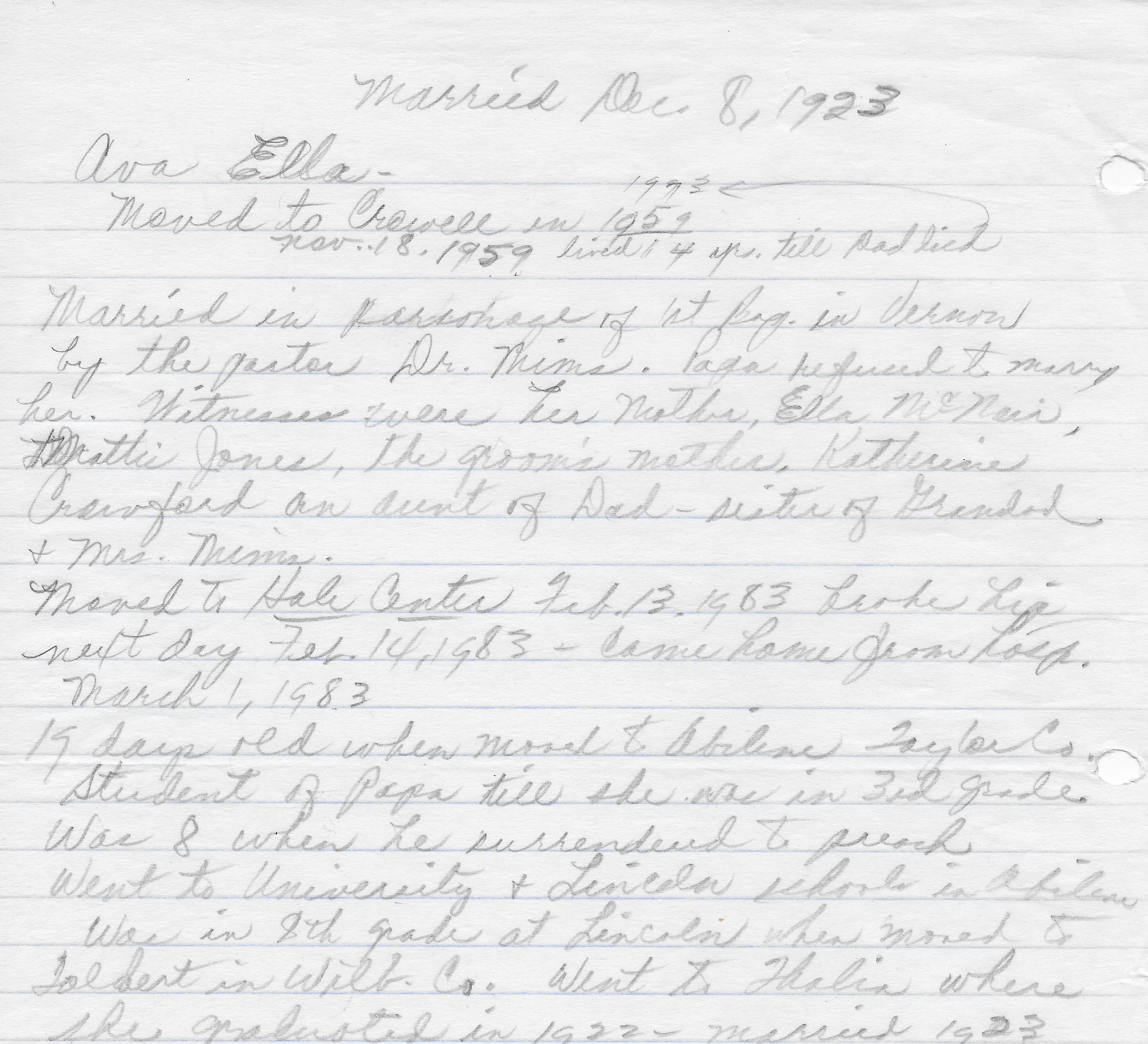
dropped out. He courted Ava McNair in a
horse drawn carriage. He once took her
to a party and left with another girl.
His brother, Hugh, had to take Ava home.
When they decided to get married, Ava’s father, Frank McNair, was
adamantly against it. Frank knew the
night that they were going to ask him if they could get married, and he went on
to bed before they got home. They went
in to his bedside anyway to ask for his permission. He said she could if that is what she wanted,
but that he would not bless the marriage.
Even though Frank was a minister, he did not even attend the
marriage. They were married on 8 Dec
1923 in the parsonage in Vernon
by Dr. Mima.

After the
marriage, they lived with Martin Harmon and Mattie Belle for a while. Joe Carroll farmed all day, and when they
could establish themselves in a home, he also began working in the cotton gin. His job there was to poke the cotton through
the first machine to keep it from becoming jammed in the claws that rotated to
shred the cotton. The machine snagged
his glove and pulled his whole arm into the machine which was brushing his
head. They worked day and night to save
his life, and the recovery lasted for the better part of a year. There were complications with the arteries
and veins rotting and breaking loose, causing it to hemorrhage. He eventually lost his thumb, but the hand
was saved. This was his left hand, and
since he was left-handed, he had to learn to do most things with his right
hand.
Early in
their marriage, they were also faced with complications during the birth of
their first child, Reitha Jo, in 1925.
It was an extended labor and Jo was stuck in the birth canal. Forceps were finally used, yet Jo was born
with physical deformities. Four more
children (Martin, Carolita, Doris, Faye) were born between 1926 and 1931 with
no further problems. This was during an
era when people kept those with disabilities from the public eye. Jo did attend school with her brothers and
sisters until it became too obvious and difficult. She was teased by the other children. They eventually took Jo to the Masonic Hospital
in Dallas, Texas, and were told that nothing could be
done for her. They were given the option
of leaving her there to be taught life skills, but Ava did not have the heart
to leave her. They brought her home and
she lived with them until the end of her life.
They lived
and raised their children in the Thalia community during the Great
Depression. Thalia had a nice school,
several churches, a grocery store, gas stations, a lumber yard, 2 cotton gins,
and when the highway was paved, the community thrived. They had to work hard, but the family was
always clean, clothed and well fed.
When Joe
Carroll finally purchased a truck, he no longer worked in the cotton gin. He began working for the Highway Department
hauling supplies for them. Eventually,
he purchased 2 more trucks and kept his brothers in work. As a part time job, he used one of his trucks
as a school bus. In his younger years,
these trucks and his temper were his downfall.
At that time cars had to be cranked, and in cold weather, that proved
problematic. His temper would flare, and
he was known to throw the crank through the crank case, so his temper could be
expensive. At other times, he would rant
and rave, and Ava would always say, “That’s enough, Carroll.” He was a worry wart and Ava would get
frustrated with him. Carolita remembers
Ava telling him. “You act like you don’t have any faith at all.”
About 1934,
Joe Carroll and Ava purchased a butane refrigerator which eventually exploded
and burned down their home “on the hill” and everything in it. Fortunately, the family had gone for a ride
and no one was home. They had only the
clothes on their backs and the children were all barefoot. They drove to Electra that night to stay with
Ava’s parents. Joe Carroll returned to
Thalia, and when he found a place for them to rent, he sent for the
family. The community had a shower for
them to help replace some of their things.
Eventually, they were able to make a down payment on a home in downtown
Thaila in 1939. Joe Carroll moved
another small house onto the back of their property for his parents, and Ava
took care of them for the rest of their lives.
Joe
Carroll’s father died in 1950, and sometime around 1957 or 1958, Joe Carroll and Ava moved to Crowell, Texas. Joe Carroll also moved the little house that
his parents lived in and located it near their property in Crowell so that
Mattie Belle could live near them. Joe
Carroll farmed on his own and worked for a large landowner, Guy Crews. He made good money because it was rich land,
and he would get a portion of the crops for working the land. When he got enough money together, he
purchased his own land, about 180 acres closer to Crowell. He still worked land for Guy Crews, but Guy’s
nephew proved to be a thorn in Joe’s side because he wanted the land. The family did well living off the land. Joe Carroll eventually hired a large Mexican
man, Ike.
.jpg)
Joe Carroll
loved riding horses and he always owned a horse. I remember one very special horse, Ginger,
and oh, how he loved that horse! He rode
quarter horses in parades, and he lived for the Santa Rosa Roundup. He rode in that parade every year, and I
remember seeing him ride Ginger. He
raised pigs on his farm, and he would take me out to see the piglets. He told me that we don't name the pigs because we don't keep them, but I would name them all for myself anyway. He also had cattle,
but I wasn’t very interested in them. It
was obvious how much he loved the land and how much he invested in it. In May 1971, he was named as the first
Conservation Farmer of the Year by the newly organized Foard County Soil and
Water Conservation District. He was
presented the award at the Lions Club luncheon on May 18, 1971. During the prior 3 years, he had accomplished
: 8,327 feet of parallel terraces; 2,809 feet of diversion terraces; 2 acres of
grassed waterways; 96 acres of conservation cropping system; 96 acres of crop
residue management; 96 acres of contour farming; 18 acres of pasture
management. It was a proud day in his
life and he said, “It gives me a good feeling knowing I have fixed my land up
the best way I know how.”
Both Joe
Carroll and Ava were devout Christians and were an important part of the First Baptist
Church in Crowell, where
Joe Carroll was always a deacon. Joe
Carroll taught a men’s Sunday school class and was a lay person. He would be called to fill in at area
churches as preacher. He was also a
dedicated Mason and was a huge influence on my dad, Truman Bryan Quillin. Truman re-dedicated his life and was baptized
as an adult because of Joe Carroll.
Joe Carroll
could often be found down by the town square in Crowell. He would gather with his buddies and they
would play dominoes. He was nicknamed
“Skinny” in his early years, and most people in Crowell referred to him by that
name. He also loved to play croquet. Polished
shoes were a must and he wore a shirt and tie every single day. I remember many times his tie was braided
leather with a silver clasp. He lived
his life well and gave of himself to others and the community. Through him other people found opportunities
to better themselves. I loved him…he was
my Pappy!
Late in
life, he became dependent on Vicks 44 cough syrup because he always struggled
with inner ear infections and a cough.
He contracted a non-infectious meningitis which affected his nervous
system, and the last several months were a struggle for him and those who loved
him. He died on May 9, 1972.


.jpg)




.jpg)
.jpg)

.jpg)